
GBP/USD steady as markets brace for blockbuster Fed–BoE week
- GBP/USD needs daily close above 1.3350 to challenge 1.3400 handle.
- Federal Reserve expected to announce a possible “hawkish cut” this week.
- Bank of England rate cut likely as UK labor market shows weakness.
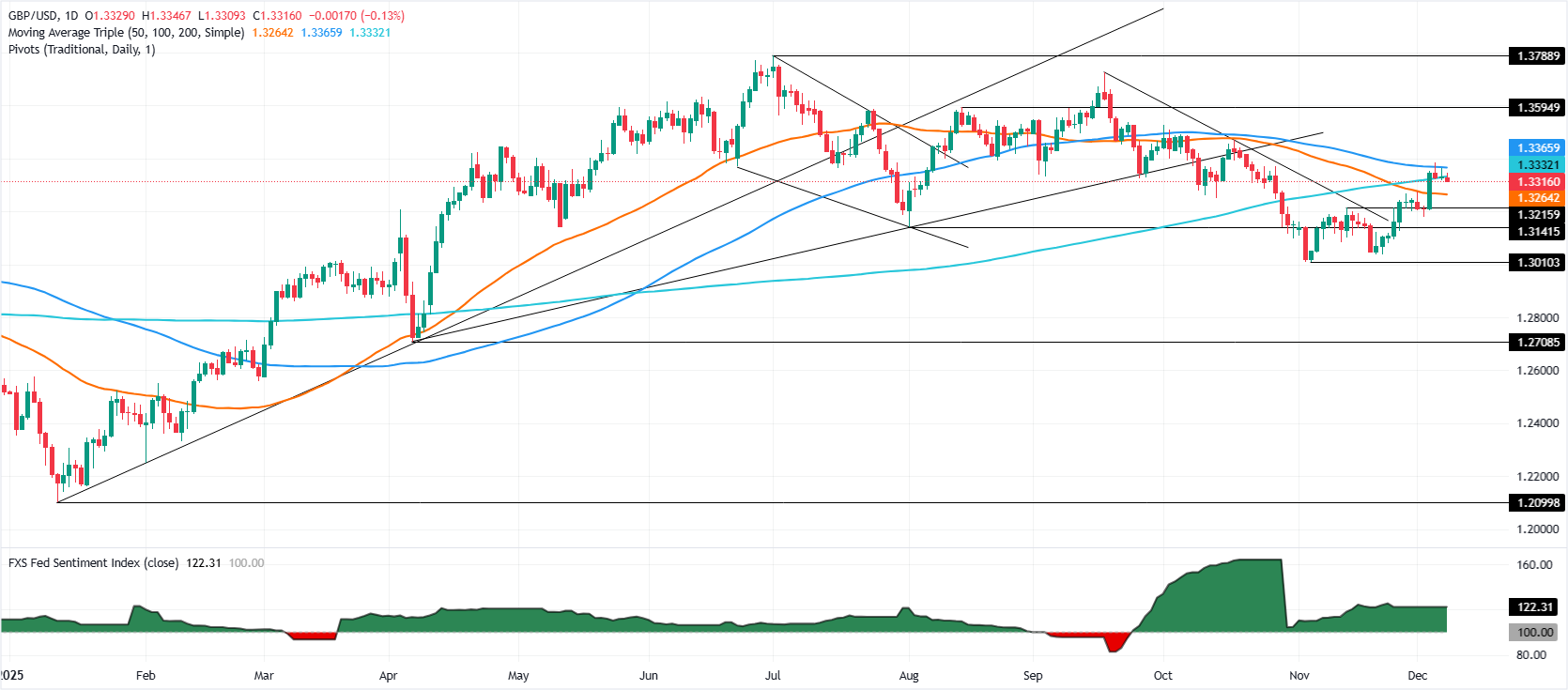
GBP/USD holds firms at around 1.3325 below the 200-day Simple Moving Average (SMA) of 1.3329 as investors wait for the Federal Reserve’s monetary policy decision, which kept the US Dollar steady across the G10 FX board.
GBP/USD tests key resistance zone as Investors await central bank moves
On Wednesday December 10, the Fed will unveil its last policy decision, with traders pricing in an 86% chance for a 25 basis points (bps) rate cut. Most analysts expect a possible Fed “hawkish cut,” in the statement language. The members of the Federal Open Market Committee (FOMC) would update their economic projections for the next year, laying the path of interest rates for the future.
In the UK, Gross Domestic Product (GDP) figures for October are due on Friday, with economists expecting 1.4% growth YoY, and an expansion of 0.1% MoM from the September reading.
Despite this, the labor market has shown signs of weakening, which keeps money markets pricing in an 87% chance of the Bank of England (BoE) cutting rates at the December meeting.
In the meantime, an earthquake hit Northeastern Japan, revealed Nikkei Asia. They wrote “A powerful quake with a preliminary magnitude of 7.6 struck northeastern Japan late Monday night, with the weather agency issuing a tsunami warning for coastal areas of Hokkaido as well as Aomori and Iwate prefectures.”
GBP/USD Price Forecast: Technical outlook
The GBP/USD retreated from around the 200-day SMA, an indication that sellers are leaning to that key resistance level. Although momentum remains bullish as depicted by the Relative Strength Index (RSI), buyers must achieve a daily close above 1.3350, so they could be poised to challenge the 1.3400 handle.
On the flip side, if GPBP/USD drops below 1.3300, expect further losses, with traders eyeing the 50-day SMA at 1.3262 ahead of the 20-day SMA at 1.3193.
Pound Sterling FAQs
The Pound Sterling (GBP) is the oldest currency in the world (886 AD) and the official currency of the United Kingdom. It is the fourth most traded unit for foreign exchange (FX) in the world, accounting for 12% of all transactions, averaging $630 billion a day, according to 2022 data. Its key trading pairs are GBP/USD, also known as ‘Cable’, which accounts for 11% of FX, GBP/JPY, or the ‘Dragon’ as it is known by traders (3%), and EUR/GBP (2%). The Pound Sterling is issued by the Bank of England (BoE).
The single most important factor influencing the value of the Pound Sterling is monetary policy decided by the Bank of England. The BoE bases its decisions on whether it has achieved its primary goal of “price stability” – a steady inflation rate of around 2%. Its primary tool for achieving this is the adjustment of interest rates. When inflation is too high, the BoE will try to rein it in by raising interest rates, making it more expensive for people and businesses to access credit. This is generally positive for GBP, as higher interest rates make the UK a more attractive place for global investors to park their money. When inflation falls too low it is a sign economic growth is slowing. In this scenario, the BoE will consider lowering interest rates to cheapen credit so businesses will borrow more to invest in growth-generating projects.
Data releases gauge the health of the economy and can impact the value of the Pound Sterling. Indicators such as GDP, Manufacturing and Services PMIs, and employment can all influence the direction of the GBP. A strong economy is good for Sterling. Not only does it attract more foreign investment but it may encourage the BoE to put up interest rates, which will directly strengthen GBP. Otherwise, if economic data is weak, the Pound Sterling is likely to fall.
Another significant data release for the Pound Sterling is the Trade Balance. This indicator measures the difference between what a country earns from its exports and what it spends on imports over a given period. If a country produces highly sought-after exports, its currency will benefit purely from the extra demand created from foreign buyers seeking to purchase these goods. Therefore, a positive net Trade Balance strengthens a currency and vice versa for a negative balance.